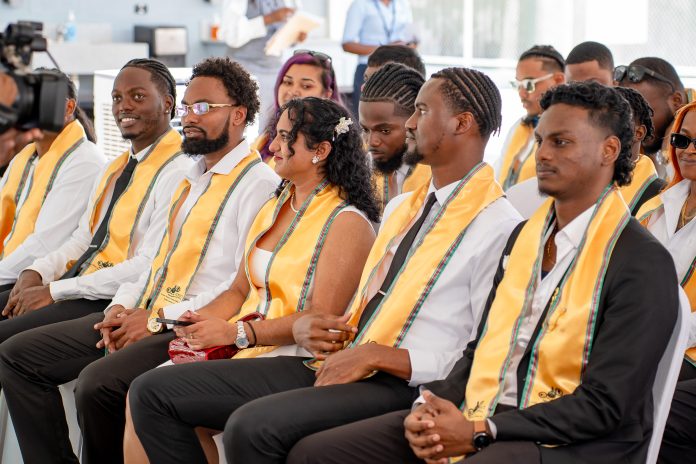
For the first time, the full 18-month Oil and Gas technician training program is being completed entirely in Guyana. In a significant leap in local capacity building, the Guyana Technical Training College Inc. (GTTCI) in Berbice now offers what once took months of study in Canada.
GTTCI Director, Professor Clement Sankat, said on ‘Starting Point, The Oil & Gas Edition Podcast’, “Since the advent of the facility simulator in 2024, two batches of Guyanese students were trained right here [Guyana]…there’s a third batch now…Overall, there are about 104 graduates, with another 28 in training. No more sending our students to Canada.”
Guyana now delivers every phase of training for local offshore technicians, from classroom learning to simulatorbased exercises. Previously, students in the SBM Offshore Trainee Technician program had to complete nine months of coursework at Nova Scotia Community College and Cape Breton University in Canada.
With GTTCI fully operational, Guyana can train and certify its own workforce to global standards. “We have a quality program where our graduates can not only work in Guyana, but have a global passport to success in the oil and gas industry,” Sankat said.
GTTCI results from a partnership between the Government of Guyana, Stabroek Block operator ExxonMobil Guyana, and SBM Offshore Guyana, supported by an investment publicly cited at USD100-120 million. Phase 1 covers oil and gas training; Phase 2 will establish a Hospitality and Tourism Institute; and Phase 3 will expand into broader technical skills.
“The planning has been about the curriculum, the learning outcomes, the people who will be trainers, and global accreditation,” Sankat explained. “This college will produce programs that are not only nationally but globally accredited,” he said. The GTTCI Oil and Gas courses are globally accredited.
18-Month Program The flagship program trains technicians in mechanical, electrical, instrumentation, and process production for work on Floating Production, Storage and Offloading (FPSO) vessels operating offshore. It unfolds in four distinct phases.
The first three months build foundation knowledge, the structure of the industry, health, safety, and environmental principles. “Health and safety are central to all the training we do,” Sankat said.
The next nine months cover hands-on instruction in well-equipped labs and workshops. “We have 12 to 14 instructors, all expatriates,” he said. “They know the equipment and the processes inside out, and they are transferring that experience to our students.”
The third phase takes place at the Facility Simulator, known as FacTor, a miniature processing plant that mirrors the equipment and procedures aboard an FPSO. SBM Offshore Guyana—a worldclass builder and operator of FPSOs—set up the simulator.
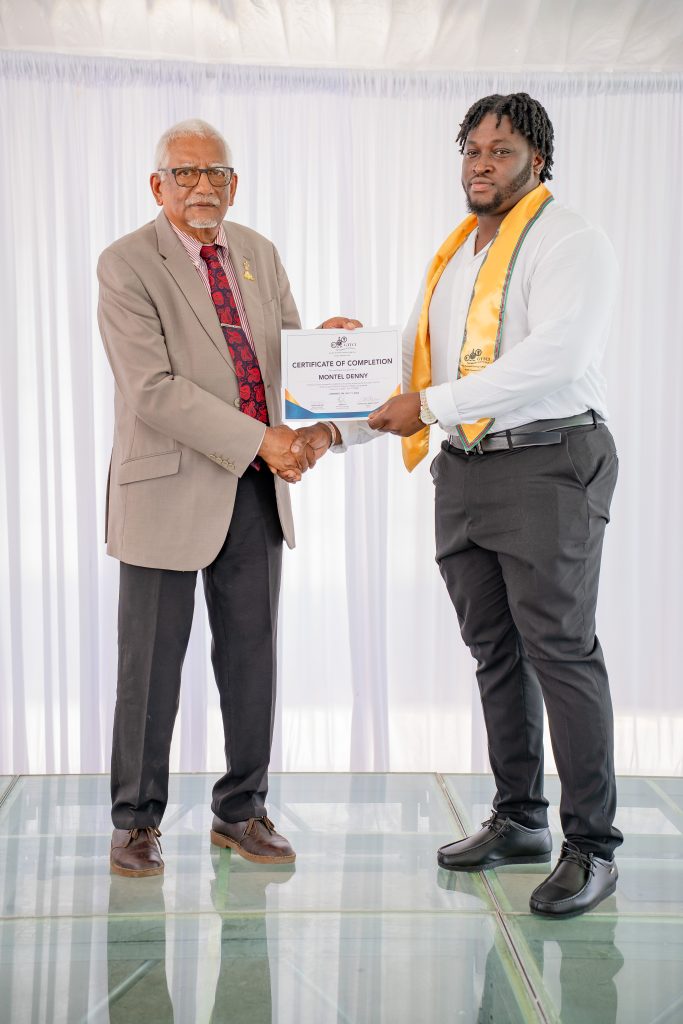
“It’s really like a little factory,” Sankat said. “Students get real, hands-on experience with actual equipment under the supervision of master craftsmen.” The final phase involves evaluation and competency testing. “It assesses their knowledge, aptitude, and skills to ensure they are ready to work on the ships,” he added.
Built for the Nation The college’s location in Port Morant, Berbice, was a deliberate decision to extend opportunity beyond Georgetown. “We are hoping that in this rural area we will develop a college town,” Sankat said. “When you build things in Berbice, you create a place for people to live and learn.”
“We will have Guyanese from all over who meet the requirements and have an opportunity to study at the GTTCI…they will have a place to live and stay,” he said. The College is constructing a multi-purpose hall and apartments for about 105 students and staff, which Sankat expects to be completed by Q3, 2026.
While the first phase of training focuses on the oil and gas industry, GTTCI has a broader objective. Sankat said, “I am very hopeful that the next phase…will go beyond the FPSOs to support a petrochemical industry…to train technicians for refineries, ammonia and urea plants, and foodprocessing.”
He added that plans are also in place for a Building and Construction Technician program that will address infrastructure standards and sustainability. “We need technicians who can ensure our buildings, roads, and bridges meet quality standards and environmental requirements,” he explained.
Every aspect of GTTCI aligns with international norms. From curriculum design to the selection of trainers, its training models mirror best practices in the energy-training sector.
“The planning has been holistic…not just about facilities but about producing graduates who can contribute meaningfully to the world of work,” the professor explained
Students will get the technical and soft skills training that employers demand. “Our students must be critical thinkers and problem solvers… develop team-building and communication skills. They’re going to live and work together on a ship for four weeks at a time, so they have to engage each other,” he affirmed.
GTTCI complements the university and technical institute network, offering an industry-specific path for Guyanese seeking practical, high-demand skills. “We need to produce thought leaders…who understand where we came from…challenges we faced…new opportunities we have…” the professor asserted.
By establishing the GTTCI, Guyana has taken a significant step toward self-reliance in its energy workforce. The country is no longer exporting its trainees for essential skills; it is now importing expertise to train them locally and exporting competence back to the world.
“What we’re building here will not only serve our country but prepare our young people to succeed anywhere in the world,” Sankat assured.