By Gwen Evelyn
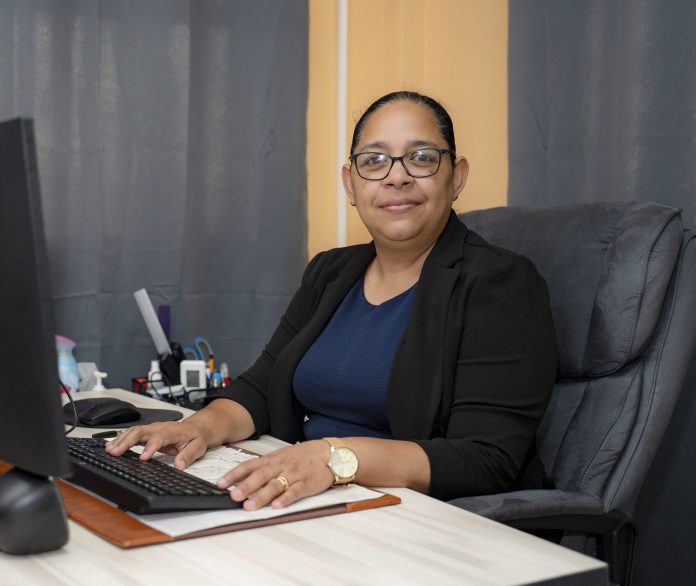
Guyana’s offshore boom has a quiet guardian. Anastasia Jessemy-Lynch sits in a small office in Kingston, making sure nothing moves in the Exclusive Economic Zone (EEZ) without clearance. As Offshore Coordinator at the Maritime Administration Department (MARAD), she leads a unit created specifically to keep pace with the country’s rapidly expanding oil and gas sector. She and her team ensure that every vessel that approaches an FPSO, or enters the EEZ to support offshore work, does so safely and by the book.
The role did not exist before Guyana’s oil find in 2015. Offshore petroleum is new to Guyana, and with it came a need for targeted oversight separate from traditional port and harbor functions.
With oil now accounting for a large share of the economy, Anastasia notes, “This industry requires us to manage this resource efficiently and collaborate with all stakeholders. It requires strategic leadership. All of this has to be done in tandem with safety at the top of our minds.”
Her job is to provide strategic leadership: overseeing logistics, enforcing related maritime procedures, and acting as a liaison among government, the private sector, and civil society. The unit also reviews regulations and policies, comparing local rules with international maritime standards so that Guyana’s framework keeps pace with a fast-moving industry.
Crucially, the offshore unit was designed to give the oil and gas sector dedicated and direct oversight. For Anastasia, the economic weight of the oil and gas industry makes effective regulation a national safeguard, not a box-ticking exercise. Her unit’s work sits at the intersection of safety, revenue protection and national confidence in how the sector is managed.
One of the clearest ways MARAD protects Guyana’s offshore is through control of who enters the EEZ and why. All vessels – from supply boats and survey ships to bulk carriers and, at the top of the ladder, the FPSOs themselves – require clearance before they can operate offshore. Nothing is supposed to move around the FPSOs or undertake “in-water activities” without permission.
For vessels that support FPSOs and offshore operations, MARAD issues in-water activity (IWA) permits, also called EEZ permits. Only authorized local agents, in line with the Local Content Act, can apply, and they must be Guyanese-registered, tax-compliant, and in possession of a local content certificate.
Applications arrive electronically at the offshore unit, where inspectors scrutinize documentation to ensure vessels are seaworthy, certificates are current, and operations comply with local and international standards. Surveyors then examine the proposed operating area to avoid conflicts with other activities. In straightforward cases, the process takes about three days; if anomalies arise, it can take longer as agents update documentation or adjust plans.
Crude-lifting operations follow a similar logic but a slightly different procedure: tankers do not receive long-term permits, but time-bound clearances for the 48-hour lifting window once MARAD is satisfied the vessel is safe and compliant.
360° audit
The FPSOs – the floating production, storage and offloading vessels at the heart of Guyana’s oil story – are subject to particularly intense scrutiny. MARAD conducts annual marine inspections on every FPSO. Two dedicated ship inspectors travel offshore each year to carry out what the coordinator calls a “360° audit.”
They check compliance with conventions such as MARPOL and SOLAS, examine crew competence and training records, and look at how often drills are held and incidents are logged.
Nothing is too small: a water spill on deck, the condition of a galley fridge, or how gas exposure is managed can all be clues to safety culture. Any anomaly triggers a deficiency note and a request for supporting evidence—such as photos and explanations—to confirm that the issue is being addressed or has been resolved before a permit is issued. A permit may also be suspended if anomalies are not resolved.
The offshore unit’s work does not stop at 4:30 p.m. While office hours run through the day, Anastasia remains reachable by phone around the clock, reflecting the 24-hour nature of offshore production.
Behind the scenes, MARAD’s emergency response division provides an additional layer of protection, conducting 24-hour monitoring of offshore activities and tracking vessels using systems such as the Automatic Identification System (AIS) and Long-Range Identification and Tracking (LRIT) for Guyana-flagged ships. An unexpected change in position is treated as a potential anomaly.
If an unauthorized activity or safety concern is detected, the team begins coordinating a response, often alongside the Coast Guard and Environmental Protection Agency.
Under Guyana’s oil spill legislation, MARAD serves as deputy incident commander in the event of a spill—an evolving role as capacity continues to grow. This framework is already being tested and strengthened.
The offshore coordinator’s role has evolved alongside the sector. When she took up the position just over three years ago, the unit was largely logistics focused.
As production increased, FPSO numbers rose, and crude lifts accelerated; the demands on the unit multiplied. The team must constantly brainstorm on how to accommodate new services, vessels, and operational needs while maintaining standards and keeping processes manageable for both industry and regulator.
MARAD participates in exercises such as ExxonMobil’s oil spill response training, not as a passive observer but as a regulator ensuring drills are relevant, targeted, and inclusive.
Anastasia describes the industry as demanding but manageable, thanks to teamwork and coordination. She sees the offshore unit’s work as part of a broader national effort: ensuring that the benefits of oil and gas are realized in a way that is safe, sustainable, and fair – and that the opportunities now available offshore help create a legacy for current and future generations of Guyanese.