Published by OilNOW
Guyana’s Natural Resource Fund (NRF), which receives billions of dollars a year from offshore oil production, is governed by a statutory withdrawal rule designed to smooth government spending.
The rule determines how much the government can legally transfer from the oil fund to the national budget each year, based on petroleum revenues earned in the previous year.
What is the Natural Resource Fund?
The NRF is Guyana’s sovereign wealth fund, established to manage revenues from oil production in the Stabroek Block, operated by ExxonMobil. The fund receives inflows mainly from oil sales and royalties, which are deposited into an account held at the New York Federal Reserve Bank.
Money in the NRF can only be withdrawn according to rules set out in law and approved by parliament during the annual budget proceedings.
How the withdrawal rule works
Under the current framework, the maximum amount that can be withdrawn in any given year is calculated as a percentage of petroleum revenues deposited in the NRF during the preceding year.
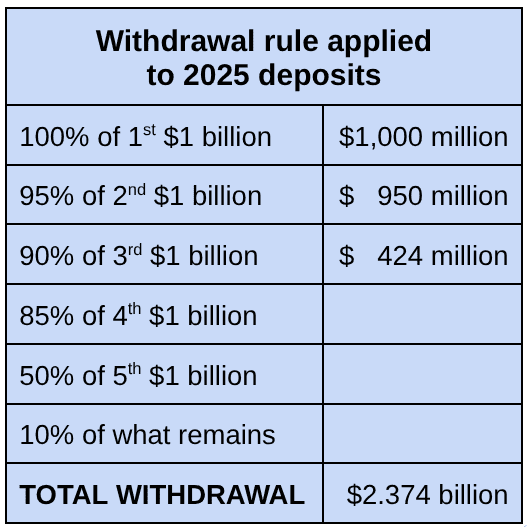
The withdrawal formula allows the government to take 100% of the first US$1 billion deposited in the prior year, 95% of the second US$1 billion, 90% of the third US$1 billion, with progressively smaller percentages applied to additional tiers, falling to 10% on amounts above US$5 billion.
For example, in 2025, US$2.47 billion in oil revenues was deposited into the NRF. The application of the NRF withdrawal rule to the 2025 deposits derives an allowance of US$2.37 billion.
The withdrawal rate increases gradually as the size of the fund grows, allowing the government to access more resources over time while still retaining savings for the future. In practice, this means higher oil revenues in one year translate into a higher legal withdrawal ceiling for the following year.
Once the maximum withdrawal is calculated, the government decides how much of that amount it actually wants to transfer to the budget, subject to parliamentary approval.
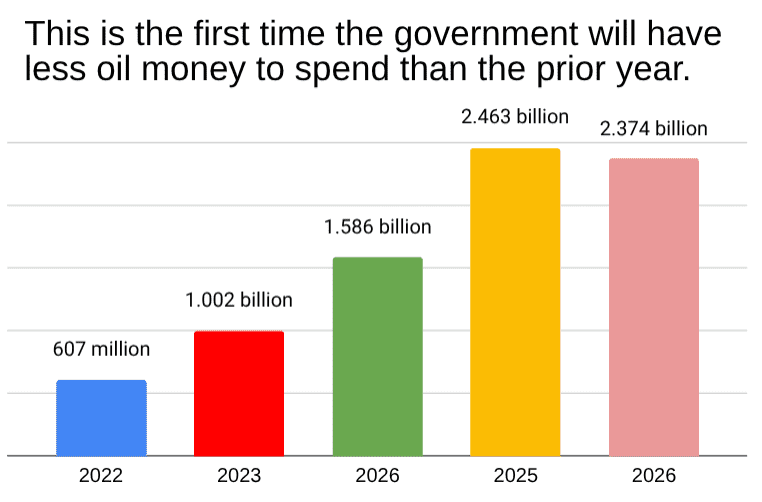
For every year, as revenue surged, the withdrawal allowance grew, except in 2025. In that year, low oil price resulted in a slight decrease in revenue from 2024, despite an increase in oil production. This resulted in 2026 being the first year the government will withdraw less than it did the previous year from the oil fund.
Why the rule was changed
Guyana’s first NRF legislation, passed in 2019, used a more complex formula that drew criticism. Critics argued the rule was difficult to understand, weakened transparency and gave excessive discretion to the finance minister.
After taking office in 2020, the current government amended the law, replacing the earlier formula with a simpler, more predictable rule.
What the rule is meant to achieve
The withdrawal rule serves several purposes:
- It is easy to understand.
- It links spending to actual oil income already received, rather than future price or production assumptions.
- It preserves a portion of oil revenues for long-term savings.