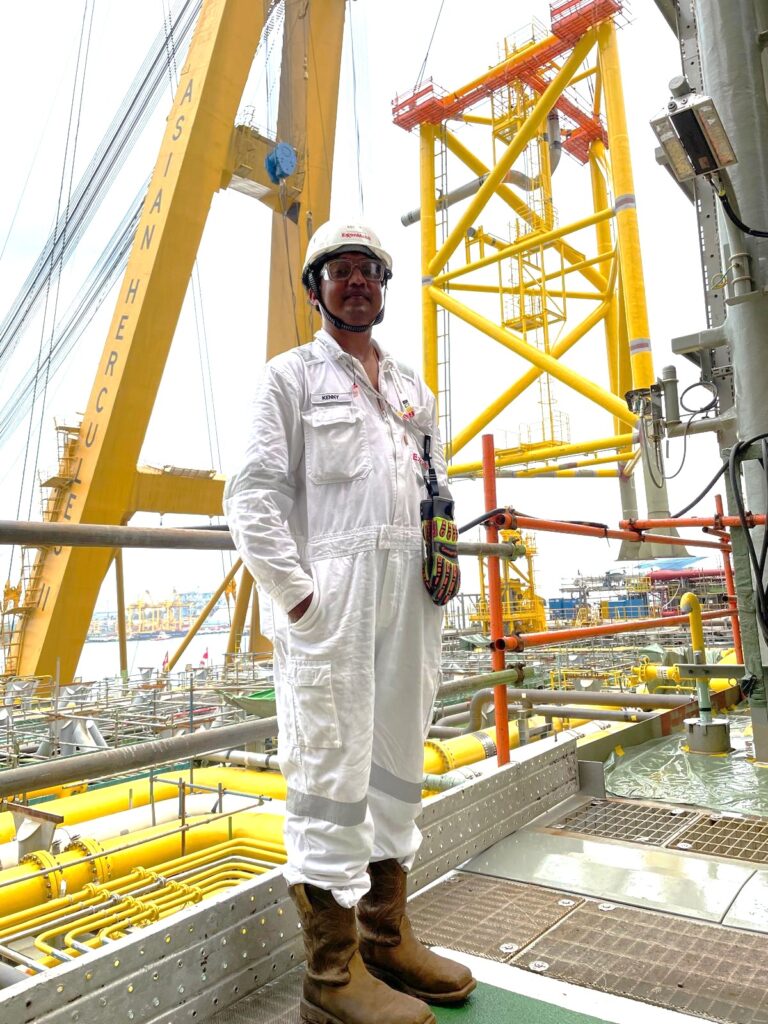
When Guyana’s newest Floating Production, Storage and Offloading vessel (FPSO), the ONE GUYANA, achieved first oil on August 8, one of the Guyanese engineers at the heart of its journey was Kenny Bissoon, a Commissioning Engineer at ExxonMobil Guyana. Bissoon’s role spanned continents, technical disciplines, and months of preparation to bring the massive offshore facility online.
“The ONE GUYANA FPSO was constructed between Singapore and China,” Bissoon explained. “The modules were built in those two countries. My role as a system owner in the beginning was to be the interface between construction and commissioning.” In practical terms, this meant ensuring that the topside process modules were fully completed to design specifications before transitioning into operational readiness.
“Mechanical completion is confirming that the physical construction of the FPSO matches the design,” he said. “Once that’s done, the next step is commissioning, doing a slew of testing to verify that it works as designed.”
Bissoon was based in Singapore for about 18 months, overseeing the topside process system. Once construction wrapped up, commissioning began on site before the vessel departed for Guyana. He joined the crew during the second leg of the journey, sailing from South Africa to Guyana
“When we finally got offshore, the next step was to continue the commissioning work we started in Singapore,” Bissoon noted. Commissioning followed a deliberate sequence. “For a process unit, you want to commission utility systems first—safety systems, communication systems, utility, water, air, all the support systems for the main process.”
A major early task was installing the seawater lift pumps to bring water aboard to run the utility systems. “We had already worked on some utility systems in Singapore, but offshore we spent several weeks on seawater treatment, which is a big part of our utility systems,” he said.
With utilities operational, attention shifted to the hydrocarbon systems. “We prepared the separation train to receive well fluids from subsea and start processing,” Bissoon said. “We made sure all the process controls and safety systems were commissioned and did a lot of tuning and testing to make sure communications were okay.”
Only after all interfaces between subsea and topsides were aligned, and personnel were fully trained, could the facility start up. But commissioning did not end there. “Once we get First Oil, the next step is to stabilize the flow topsides and then start commissioning the compression train,” he explained. Compressors require a steady flow of gas to operate as designed, which is why flaring is permitted during startup to facilitate testing.
The ONE GUYANA’s design meant more work than its predecessors. “We’ve got more spare compressors on each train compared to the previous FPSOs, so it’s much more machinery to commission,” Bissoon said. Once the compressors were running, the team began injecting gas and water back into the reservoir while continuing crude processing until the first offload could take place.
For Bissoon, the achievement was more than a professional milestone; it was personal. Nearly 15 years earlier, he had left Guyana to work in Trinidad’s petrochemical sector. “When I left home, I felt I had to,” he said. “There was no way for me to practice as an engineer in Guyana, no way to make a decent living. It saddened me to leave my family to work somewhere else.”
The oil and gas industry’s arrival has changed that landscape. “Now I can contribute to an industry that’s developing the country to the point where no engineer, or anyone for that matter, will have to leave Guyana to make a living for their family,” he said. “That’s what fulfills me the most.”
Still, he worries that many do not fully grasp the significance of this moment. “I sometimes worry that Guyanese people don’t appreciate the gravity of what we have now. We’ve never had a shortage of aspirations, dreams, or ambition — just a shortage of opportunities,” Bissoon stressed. “You can dream all you want, but without opportunities, you won’t get anywhere.”
He sees the sector as offering unprecedented possibilities. However, he cautions that seizing them requires initiative. “This is a very technical industry. Anywhere in the world, there’s a learning curve when you start up an industry like this. That’s not a handicap, you have to start somewhere,” he said. “Don’t wait for people to give you anything. Go and get it.”
Bissoon believes the path forward requires boldness and personal accountability. “We’ve got to take ownership of our success. Good things can happen if we approach it that way,” he said. “We must not let the opportunities slip us by. There are a lot of them — you just have to have the initiative and drive to get up and go after them.”
For the commissioning engineer, who helped sail the ONE GUYANA home and bring it to life, that drive has defined his journey, and he hopes it will define the next generation of Guyanese engineers who no longer have to leave home to find their place in the world.